
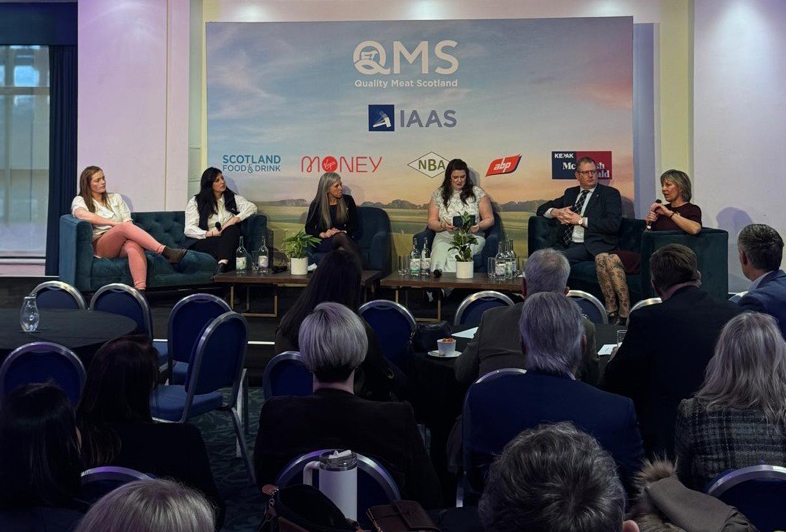
Yesterday we had the pleasure of attending Quality Meat Scotland’s (QMS) Future Thinking on Red Meat Conference, and one word kept surfacing throughout the day.
Story.
Because across every session, whether exploring global protein demand, Scottish livestock supply or consumer behaviour, the same message emerged: the sector has the evidence, the opportunity and the product. The challenge is making sure that story is heard.
Across a programme that brought together perspectives from farming, government, science, retail, and hospitality, a clear picture emerged of a sector with a strong story to tell, grounded in world-class production standards, nutritional evidence and deep roots in rural communities.
One of the most striking aspects of the conference was how often the same signals surfaced from very different speakers across the supply chain. From global market analysts to auctioneers, retailers and policymakers, the data points were remarkably consistent.
Demand for protein continues to rise globally and is expected to grow significantly by 2030. At the same time, livestock numbers are tightening across several traditional producing regions including North America, the EU and Australia. Carcass weights may be increasing, but overall animal numbers are falling, creating a tightening supply picture.
The initial panel session brought this into sharp focus. Bringing together all 12 members of the Scottish Red Meat Resilience Group, the discussion centred on how Scotland responds to the livestock supply challenge and what that means for the future of the national herd.
The opportunity is significant. QMS modelling suggests the UK will need to produce an additional 278,000 tonnes of beef by 2030 to meet projected demand, with Scotland’s share around 22,000 tonnes, equivalent to roughly 79,000 additional breeding cows. Even relatively modest increases, such as adding a couple more cows per herd each year, could collectively make a meaningful difference.
These insights underpin the Meating Our Potential campaign, which QMS and the Scottish Red Meat Resilience Group have developed to help build confidence across the sector and support sustainable growth in the national herd. It was particularly interesting to hear the campaign discussed during the day, having been proud to support QMS on this work from a producer and political engagement perspective.
The conference also explored how consumer behaviour is evolving. Health consciousness continues to shape food choices, reflected in the rise of scratch cooking and growing demand for natural sources of protein. Even emerging trends such as the increasing use of weight loss medications, now used by around 4% of the UK population, were discussed as a potential opportunity. As calorie intake falls, the focus naturally shifts towards foods that deliver greater nutritional value per portion, something red meat is well positioned to provide, as highlighted through the scientific evidence on nutrition shared during the day.
There were also important signals from government. In what was her final address as Cabinet Secretary, Mairi Gougeon reaffirmed that livestock remain central to Scotland’s rural economy and communities, while reiterating that the Scottish Government has no plans to introduce policies aimed at reducing livestock numbers.
The conversation also touched on the importance of reputation and narrative. As several speakers noted, the public conversation around red meat has shifted in its favour in recent years, but it remains a fast moving and sometimes volatile space. Maintaining trust will require continued transparency, evidence and clear communication.
For us as a communications agency, it was striking how often the discussion returned to the importance of communicating the sector’s strengths effectively. Scotland’s red meat industry has incredibly strong foundations, from the science and nutrition evidence to the high welfare and sustainability standards behind Scotch produce.
The overall mood across the day was one of quiet confidence. The domestic demand is there, the science is there, and government support remains firm.
Now the challenge is ensuring the sector backs itself and seizes the opportunity.
A big thank you to QMS for hosting such a thoughtful event. It was also great to catch up with many clients, colleagues and friends from across the sector throughout the day.