
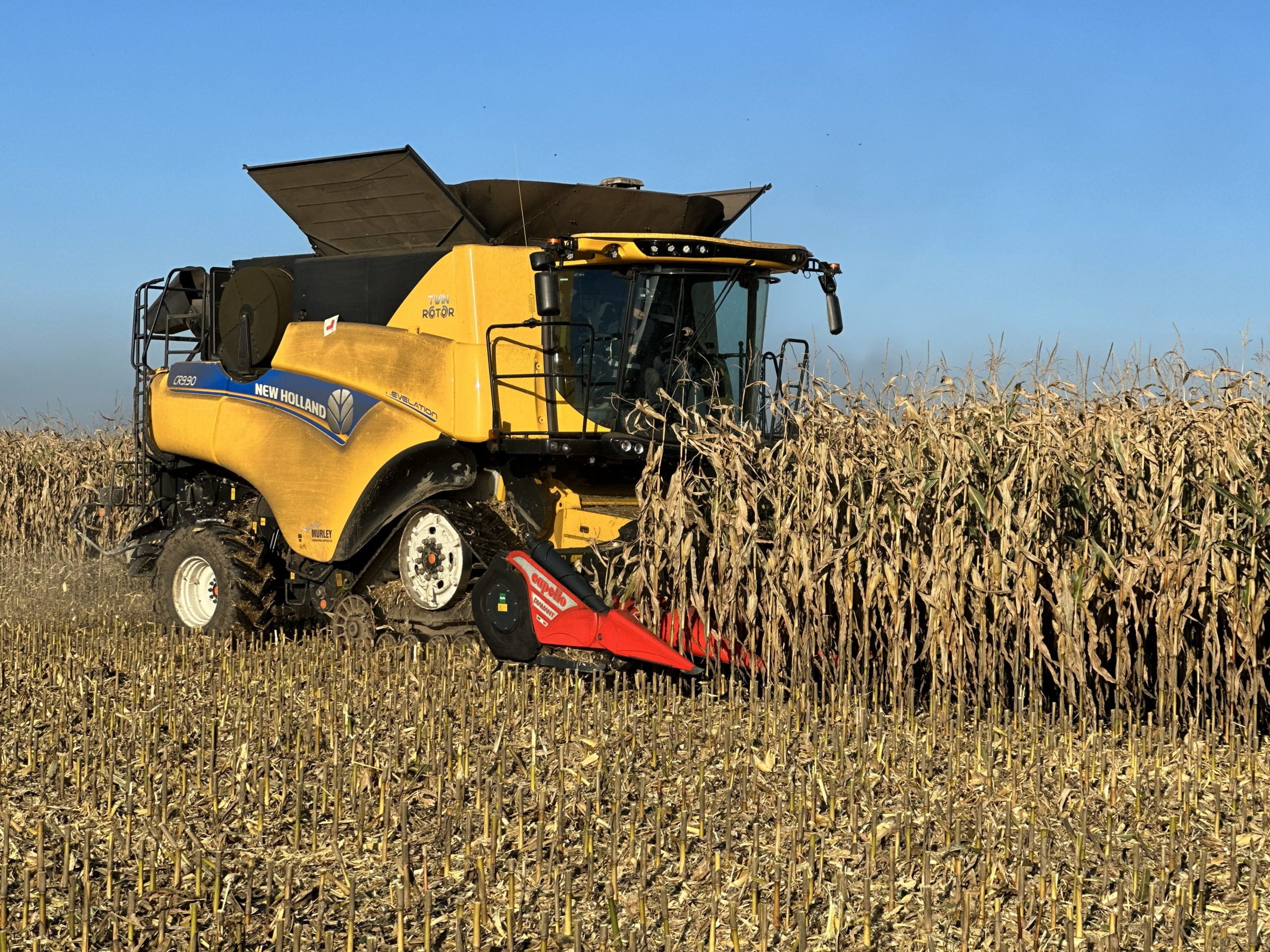

When Will Oliver first planted maize for grain five years ago on his family’s 2,000-acre Warwickshire farm, he wasn’t taking any chances. “I got into a contract because I didn’t want to grow something I might end up being unable to sell,” he explains. But fast forward to 2025, and the picture looks very different.
Now Vice Chair of both the NFU Midlands Crops Board and the Maize Growers’ Association (MGA), and confident enough to operate without contracts, Will has watched the grain maize market mature around him. “There is much more confidence in the market now, really opening up the opportunities” he says. “I’m not tied into a contract, so I was flexible. This year I sold it for forage because the conditions suited, but if I was still tied into a contract I would have been more restricted.”
That flexibility proved valuable in a challenging season, highlighting the crop’s versatility, but ultimately, it’s the economics that make the strongest case, with a gross margin more than double that of wheat in 2025.
Why Maize?
Will’s family farm sits on the historic site of the 1485 Battle of Bosworth, the last in the War of The Roses. Straddling the Leicestershire-Warwickshire border, these days he’s fighting slightly less intense battles, primarily against blackgrass. His rotation is roughly half the farm area in first wheats, with the other half dedicated to break crops. For the past six years, that’s meant maize and beans, though this year he’s added oilseed rape back into the mix.
“Maize works really well for us,” says Will. “We do cover cropping, no insecticide, companion cropping, so it lends itself well to the Sustainable Farming Incentive (SFI) when it’s open. We tick all those boxes but, crucially, we’re still producing food rather than taking land out of production.”
The crop slots neatly into his system as a valuable blackgrass break. “It’s a good break crop in the rotation, pretty good margins, and there’s less risk because you’re drilling over quite a short period, but you’ve got a fairly wide drilling window.”
That window stretches from April through to June. “We went quite early this year in April. Some people waited because they thought there was a risk of frost, but it never really materialised – though it was very dry,” he recalls. “I do want the earliest harvest possible because I want to get wheat in behind.”
Making the Investment Work
The specialist equipment required for grain maize might deter some growers, but Will sees it as money well spent when you consider the higher return. He’s invested in combine modifications – a specialist maize header plus special sieves and concave.
The farm already had a continuous flow grain dryer capable of handling maize, which was one factor that made the move into grain maize attractive. “I know when I grow maize I have to dry it, so I budget for it – it’s not a problem. Whereas if you grow wheat you might have to dry it, you might not. With maize we know we have to.”
Last year they dried maize for an average of £18-20 per tonne. “If it does ten tonnes per hectare, that costs up to £200 per hectare,” Will calculates. “That is quite a big cost, but then it’s similar to what a fungicide programme might end up costing on wheat.”
He’s achieving yields of between seven and ten tonnes per hectare dried, with the crop receiving a premium over wheat prices.
Multiple Markets, Multiple Opportunities
Without a contract tying him down, Will now sells to several outlets. His grain goes to Avara for poultry feed, and to GLW Feeds via Frontier, but he’s also developed local markets with shoots and livestock farms.
This fits perfectly with his diversified farm enterprise. Alongside the arable operation, the family runs a significant poultry enterprise, with Will’s father at the helm while Will manages day-to-day arable decisions. His younger brother handles property development, his wife runs their glamping site and dog walking business, and the family lets out commercial units, a quarry, and fishing lakes.
“Poultry is very important to us for cashflow – every six weeks you’re getting a cheque,” says Will. “If you have a bad year in arable it’s a body blow, and quite often it rolls into two years. But the enterprises work really well together. We put wheat into the poultry, we put muck from the poultry into the maize and wheat, and then we sell our wheat, beans and maize to Avara. It’s all going back into the poultry sector somewhere – there’s a good circular system there.”
Will has also partnered with a neighbouring sheep farmer who runs Bentley Suffolks. “I don’t know anything about sheep, but I’m quite happy having sheep on the farm,” he laughs. “He and I are a similar age; we work well together. I charge him per head per week, he does all the fencing and he lets me know at the end of the year what grazing he’s done.”
The sheep graze cover crops after harvest, with Will typically using rye and vetch, though he’s tried radish and mustard on smaller areas to enable earlier drilling. “The farmer’s really good at moving them, they don’t graze too hard, he’s got plenty of ground to go at. Sometimes he might go over a second or third time but we’re not doing any damage, it only brings benefits for all of us.”
Growing Confidence
After combining the maize, Will direct drills winter wheat at a high seed rate with no pre-emergence herbicides. “Sometimes we end up writing a little bit off but it’s still worth the risk,” he says. “You do get a yield compromise, but I’m confident I’m getting that margin back in the maize I’m growing rather than doing beans or oats.”
It’s a calculated gamble that reflects his broader approach to grain maize – managing risk while maximising opportunity. “There is a risk involved with the wheat crop following, but there’s no saying you can’t do maize again, it’s not like with wheat, rape, or beans. I don’t want to do continuous maize, but in one year I could do maize back-to-back no problem if conditions dictated it.”
Will’s journey from cautious contracted grower to confident market player mirrors the crop’s trajectory in UK agriculture. As a recent appointee of the NFU National Crops Board, plus the 2025 British Farming Awards Arable Farmer of the Year, he’s well-placed to assess where the market is heading.
“Maize is definitely growing in interest,” he confirms. “The opportunities it’s bringing as an arable farmer are endless. There’s opportunity to sort of say ‘can we do maize on your farm?’ We do rent 100 acres on a neighbour’s farm and rotate it there. It works well for both of us and they’re getting a break crop.”
On 4th February 2026, Will will host day one of the MGA Annual Conference at his family’s Fenn Lane Farm near Nuneaton, where visitors will see the grain drying facilities, farm machinery, cover crops and the sheep integration in action. Following lunch, there will be talks from AHDB, NIAB and John Deere.
For Will, grain maize has proven itself as more than just a break crop. “It’s a really flexible crop with multiple markets out there. The economics stack up, it’s good for weed control, good for SFI when it returns, and there are more and more outlets, even locally.”
To read more about the benefits of joining the Maize Growers’ Association, and attending the annual conference in February, go to www.maizegrowers.com