
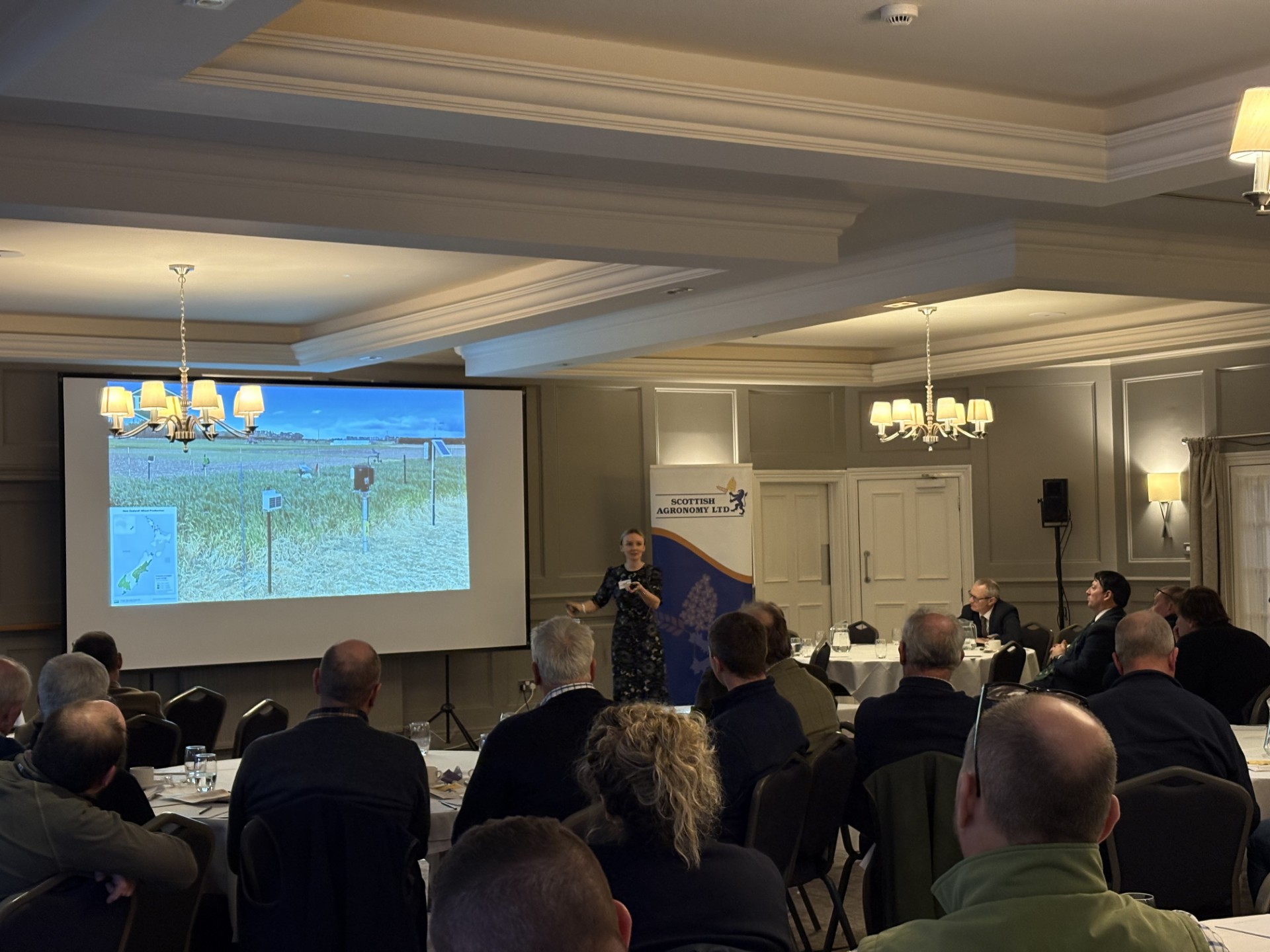
Growers from across Scotland gathered in Perth last week for the Scottish Agronomy conference to hear from scientists alongside economics and business experts about the lay of the land for crop production in the UK.
Bringing views from across the UK and Northern Ireland, Professor Paul Wilson of the University of Nottingham and Ben Abell, Head of Agronomy at Dyson Farming, talked about embedding efficiencies in farm businesses, while NIAB’s Dr Aoife O’Driscoll and Dr Ewen Mullins of Teagasc shared some of the developing science to support this, as part of the theme Prospering in Leaner Times.
“The conference is an opportunity for growers to step back from the day-to-day of the farm, meet up with other growers and get an insight into the bigger picture from a great line up of speakers with different perspectives and areas of expertise,” says Managing Director, Adam Christie.
“It allows us to consider where the trade is going and the place of agronomy and cereal and potato production within it. There was a great buzz in the room and, despite depressed markets and a wet start to the year, real positivity which is very encouraging to see.”
While warnings were made about what the CBAM fertiliser tax could cost UK producers, there was some optimism for plant breeding following the EU’s recent relaxation of regulation on gene editing.
“With what we’ve heard during the course of the day and the results from our trials, there’s plenty to think about and we look forward to supporting growers to make the most of markets and conditions over the year ahead,” added Adam.
Paul Wilson, who is Professor of Agricultural Economics at the University of Nottingham and the Director of the Centre for Food Policy and Foresight, focused on farm business performance behaviour and the context of arable farming in the wider policy and consumer environment.
Reiterating the value of keeping carbon credits on farm to meet policy makers’ future environmental goals – insetting rather than selling them all to other sectors – he also urged farmers to put pressure on the UK Government to understand the consequences of its proposed carbon tax due to be introduced next year. He warned the Carbon Border Adjustment Mechanism (CBAM), which would apply to imported fertiliser, will put UK growers at a competitive disadvantage, unless an equivalent is introduced for food produced outside the UK, and give the advantage to nations with less environmentally stringent production methods.
Ben Abell, Head of Agronomy at Dyson Farming, which grows wheat, barley, potatoes, maize, peas and rye across 14,000ha in Lincolnshire, Gloucestershire and Oxfordshire, shared its approach to constantly experimenting and being early adopters of new technology to produce efficiently.
The message from Aoife O’Driscoll, Senior Plant Specialist in Plant Pathology at NIAB, was that managing disease is key to sustainable crop production, explaining how next generation IPM – including agronomic innovations, biological options, genomic prediction models and technology evaluations – can be integrated on farm.
Ewen Mullins, Head of the Crop Science Department at Teagasc, Ireland’s Agriculture and Food Development Authority, addressed novel plant breeding technologies and integrated approaches to supporting farm viability. Dr Mullins is encouraged by the EU’s relaxation on regulations around gene edited crops which will accelerate the way for new genomic techniques to breed future varieties in some UK nations.
This year was Scottish Agronomy’s 40th annual conference, a significant milestone for the co-op, first established four decades ago by a small group of farmers looking for independent agronomy and now 240 members strong. It also marked the completion of the first George Lawrie Bursary, which was awarded to two young people in the industry to further their learning opportunities, founded last year to mark George’s retirement from Scottish Agronomy.
Cameron Smith of Kilted Farming and James Hay of Culfargie Estates were each awarded a bursary in February 2025. They presented at the conference to showcase how they had used the funds as part of a trip to Texas with the SAYFC Rural Affairs Committee to find out more about different types of businesses including the growing of rice, pecans and cotton, a lumber growing and processing operation, a cattle stud, chicken processor and a high end Wagyu beef box business. As well as returning with enterprising ideas and learnings for their own businesses, they were struck by the pro-business and light touch regulatory approach in Texas to encourage farming businesses to thrive.