
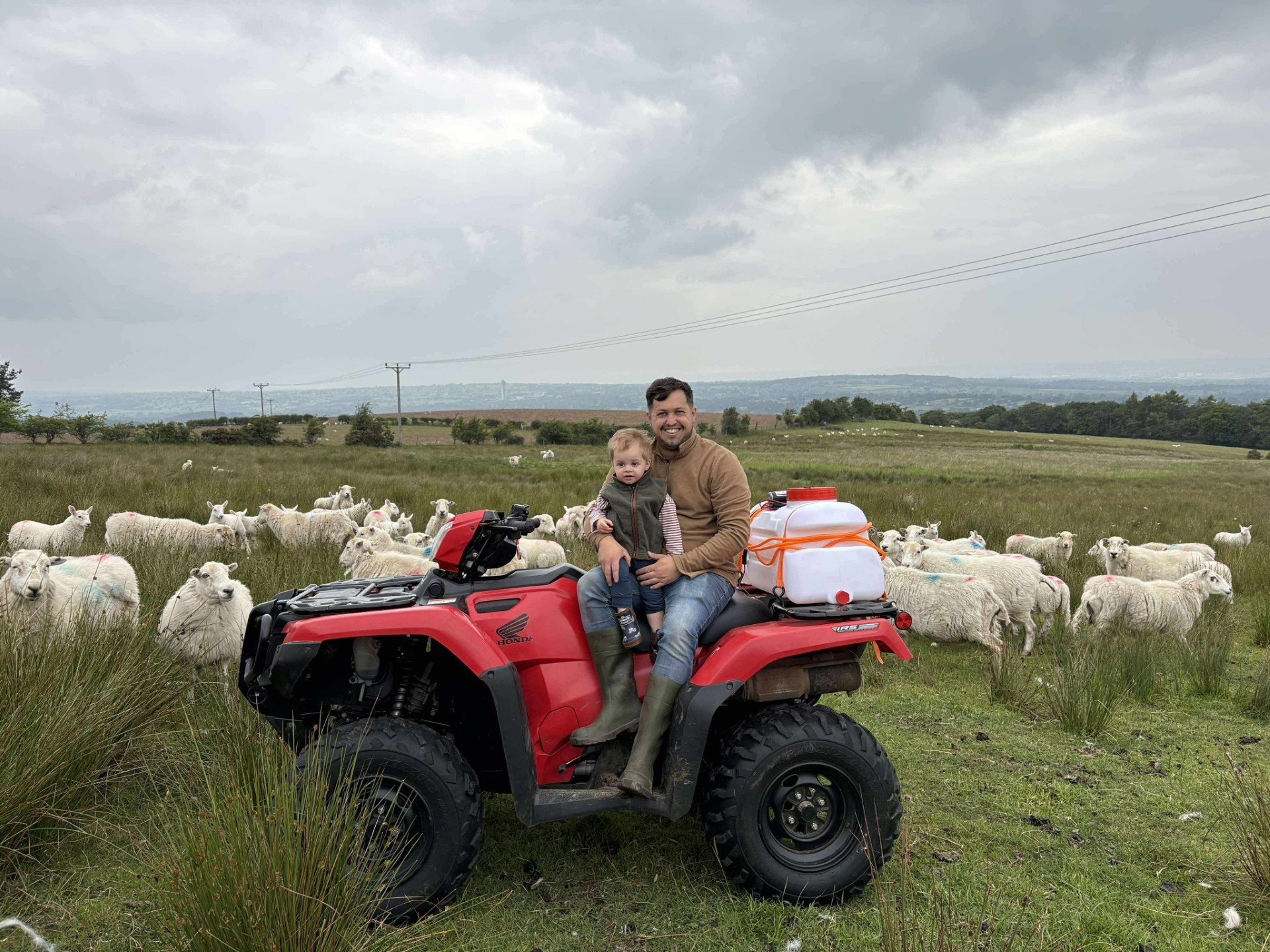
For Ben Hanmer, farming Border Leicesters isn’t just a passion, it’s a family legacy nearly a century in the making. His great-grandfather brought Border Leicesters down from Scotland back in the 1930s, and now, almost 100 years later, Ben is proudly continuing that tradition and keeping it in the family under the Cedidog prefix his grandfather originally used.
“Border Leicesters have been in the family for nearly 100 years,” explains the 34-year-old farmer from North Wales. “I’m proud to play a part in keeping them going and give them a purpose.”
That sense of purpose extends beyond his own farm. Ben now serves as a member on the Society of Border Leicester Sheep Breeders Council, where he’s passionate about promoting the breed and exploring new opportunities.
Building a Flock with Heritage
Ben’s journey back to farming wasn’t straight forward. After studying agriculture at Llysfasi College and completing a degree in Agriculture with Animal Science at Aberystwyth University, he worked in various roles across the agricultural sector. In 2017, he won the National Sheep Association Welsh Young Shepherd of the Year competition, and by 2021, he founded his own flock with two pedigree Border Leicester gimmer lambs purchased at Carlisle.
Today, Ben is self-employed, balancing his time between sheep farming, working as a sales agent for a mineral company, and taking on occasional odd jobs. He farms 62 acres near Wrexham on Hope Mountain, running 17 Border Leicesters in total with eight ewes being put to the tup, alongside 85-90 Welsh Mountain ewes.
The tenancy arrangement works well for his business model. “I quite enjoy renting at the moment because it’s all on the one business with the sales and the farming,” he says. “If more land comes up and it’s reasonably affordable, I would like to expand a little more.”
The Case for Welsh Halfbreds
While Ben maintains his pedigree Border Leicester flock, he’s equally passionate about promoting the Welsh Halfbred – the cross between Border Leicester tups and Welsh Mountain ewes. It’s here that he believes the breed truly proves its worth as a crossing sire.
“I think they’re a hardier crossbreed than other crosses,” Ben explains. “There’s a little bit more longevity in a halfbred than other breeds. You’ll get her to a five-year-old ewe that’s still a great commercial ewe at that age.”
His reasoning is both practical and forward-thinking. With farming costs rising, Ben believes more producers will shift toward later lambing outdoors to reduce expenses. “If people are going to do that, they’re going to want a hardier sheep,” he says. “Either way, if the weather gets better or worse, it’s going to be a bonus.”
The Welsh Halfbreds stand well with good frame and shape, retaining the hardiness and easy lambing characteristics of the Welsh while gaining hybrid vigour, frame, carcass quality, and milkiness from the Border Leicester. “They have a real sparkle and presence; that ‘look at me’ quality,” Ben says.
A Low-Input Philosophy
Ben runs his flock on a grass-based, low-input system by necessity and by design. His pedigree Border Leicesters lamb inside in March, with the Welsh Mountain ewes lambing outside in April. The land reaches as high as 1,000 feet, with a mix of improved grass leys and rough grazing hill land.
“I try and breed them as hardy as I can,” he says. “Everything’s grass fed. Most of the time they run alongside the Welsh ewes.”
His sheep receive no concentrates, just grass and mineral blocks. “They never had one bit of feed the last year,” Ben notes. “That’s the whole purpose, low input, easy management, and hopefully high output.”
Breeding Strategy and Bloodlines
Ben’s breeding programme is carefully managed. He sources rams from sales in Scotland -particularly Lanark – along with local sales at Welshpool. Recently he purchased two tup lambs from Lanark to bring in new blood for his pedigrees.
“I chose one to use across my pedigrees, and the other ram lamb will go with my older ram and my homebred ram lamb,” he explains. The homebred rams can’t be used on the pedigrees as they’re too closely related, so they go straight onto the Welsh ewes.
“The Border Leicesters come first in terms of the rams, and then I use them to go onto the Welsh,” he says.
Ben buys his Welsh ewes at Ruthin market, with his last two lots all coming from Gydros Farm in Cerrigydrudion. “They come from quite a hardy area,” he notes. “They’re quite expensive usually because they’re so strong as they are Nelson type ewes, but the whole purpose of the sheep was to be low maintenance, to do everything for themselves.”
While Ben has been building his Border Leicester numbers and hasn’t sold many pedigree animals yet, that’s starting to change. “Each year I’ve got a few more, so by next lambing I should have some to sell through the breeding ring,” he says confidently.
The rams he does sell go privately to commercial farms. For his crossbred lambs, Ben has developed multiple marketing channels. Last year, due to grass conditions, most went as stores to market rather than finished lambs. Some smaller lambs were recently purchased by another breeder to keep and sell as yearlings, while Ben retained some ewe lambs himself for breeding.
He’s also developed a meat box trade, selling half lambs or whole lambs in boxes to local customers.
Looking Ahead
Ben’s ambition is to build his pedigree Border Leicester flock up to about 15 lambing ewes annually while maintaining his crossbreeding programme. He’s recently increased his Welsh ewe numbers, feeling previously understocked. “I’d say I’m fully stocked now for the amount of ground I’ve got,” he says. “If land comes up here and there when it’s affordable, I’ll take it, but you’ve got to make business choices and not throw money away.”
For the Border Leicester breed itself, Ben sees challenges but also opportunities. “The sheep industry had its head turned by the Bluefaced Leicester over the last 20 years and temporarily lost sight of the Border Leicester,” he observes. “It’s great to see people going back to them or discovering them for the first time.”
He believes the breed needs better collaboration with crossbred societies. “I keep saying we need to work more with the likes of the Halfbred Society,” he says. “We need to increase the amount of ram buyers at the Border Leicester ram sales at Welshpool and other sales across the UK.”
A Family Legacy Continues
Using the Cedidog prefix connects Ben directly to his grandfather’s legacy, though the prefix history is complex – his grandfather originally used the Cedigog prefix when he started, then changed to the farm name ‘Cae Hic’ when he moved.
“It’s a great feeling to be using my grandfather’s original prefix,” Ben says. “I would like to think that he would be proud that I am not only back farming but farming his favourites – Border Leicesters.”
His grandfather had tried to push halfbreds and recording Border Leicesters years ago through a college in North Wales, though it didn’t take hold at the time. Now, decades later, Ben is carrying that torch forward, believing strongly in both the pedigree breed and its crossing ability.
“As sheep breeders we all want a ewe that lasts five years or longer,” he says simply. “You can change your traits like the tightness of fleece with the terminal sire when you’re on a halfbred. The Border Leicester gives you that foundation – longevity, hardiness, and that hybrid vigour that makes them work in a commercial system.”
For Ben Hanmer, keeping Border Leicesters isn’t just about maintaining a family tradition. It’s about proving their continued relevance in modern commercial sheep farming. And with his combination of practical experience, low-input philosophy, and genuine passion for the breed, he’s well-positioned to make that case for years to come.