


- ADAS have modelled how fungicide programmes reduce septoria damage
- Key finding: Swapping from Ascra Xpro to Revystar® XE at T1 mitigates the increase in septoria damage from drilling early
- Key finding: Variability in fungicide efficacy is the same for all fungicides
Groundbreaking new analysis by ADAS and BASF shows how to preserve yield potential this spring, revealing the T1 fungicide decisions that can mitigate the increase in septoria infection risk, associated with drilling early.
The ADAS project, led by Dr Julie Smith, used data from one of the world’s longest-standing research projects on wheat diseases, the AHDB Fungicide Performance Curves, alongside published analysis of the Defra Survey of Crop Pests and Disease. Its goal was to model how fungicide programmes reduce disease severity.
BASF overlaid the AHDB work on the impact of drilling date on AHDB Recommended List (RL) resistance ratings to discover the impact of upgrading fungicides at T1.
World-leading research
UK growers and agronomists are well-used to the annual dissemination of the Fungicide Performance Curves, but ADAS researcher Dr Frank van den Bosch highlights how unique and valuable the datasets are.
“The UK’s system is unique in the breadth and depth of the data and is an under-utilised resource. This model could not have been developed anywhere else in the world, as such long-term data sets are not collected,” he says.
The AHDB Fungicide Performance Curves incorporates 30 years of results, totalling 273 ‘site years’ of data points. Defra’s Survey of Crop Pest and Disease dates back 50 years and contains around 300 random wheat crops per year which are visited each year and scored for their pest and disease damage. Defra also collects data on the varieties and agronomic practices used.
The new model
“The model we developed uses this data to show how much disease you can expect in a crop, given the RL septoria resistance rating of the variety and the chosen fungicide programme,” explains Frank.
“There are two sources of variability. One is the disease pressure which changes from year to year, the other is the fungicide programme efficacy which is different across the years and location of the crop.”
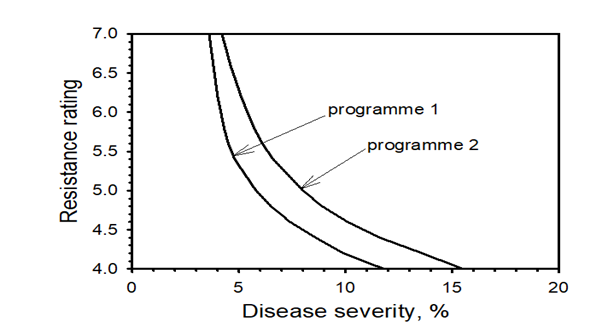
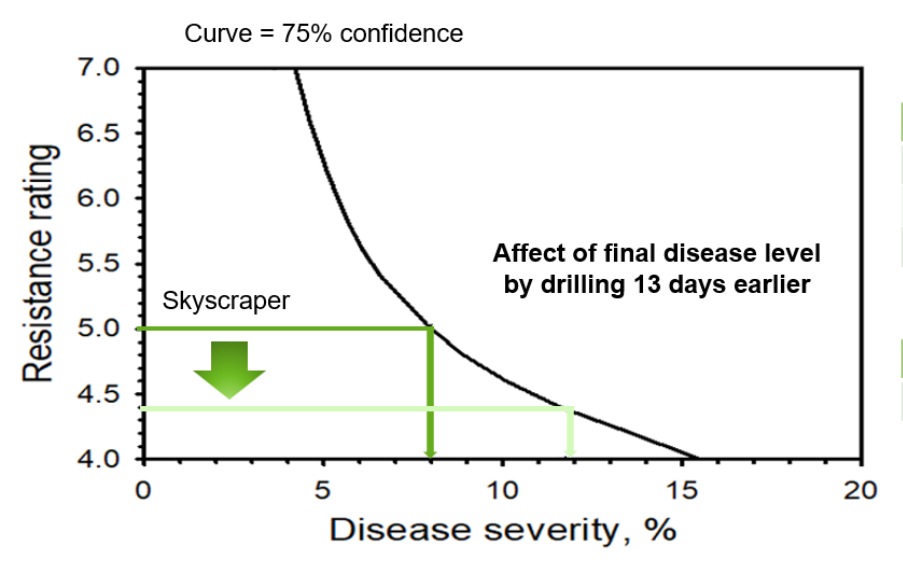
When Frank’s model combines these two sources of variability, it produces a curve, to the left of that curve are 75% of cases.
For Frank, the most surprising finding of the research was the discovery that the variability in the fungicide efficacy is the same for all fungicides.
“It doesn’t matter whether you’ve used an SDHI, an azole or a QII, the efficacy variability is identical. This is important as it allows us to model any combination of fungicides within a programme.”
ADAS modelled a variety of programmes, typical of those seen on farm in recent years, such as Revystar® XE at T1 followed by Univoq at T2 and Proline at T3 (programme 1). Frank went on to compare various scenarios including, switching the Revystar® XE for Ascra Xpro at T1 (programme 2).
The model has been successfully validated by ADAS, with three years of in-field trials.
Adding in AHDB’s drilling date effects on varietal resistance scores
“The results are fascinating and useful for our research teams,” says Steve Dennis, BASF Head of Business and Technical Development. “However, what does it mean for growers and agronomists in the UK?”
Noting the earlier drilling dates of this year’s winter wheat crops, their forwardness and industry-wide recognition of a likely increased risk of septoria, Steve and his team overlaid AHDB’s 2021 research on how drilling date affects disease pressure.
Analysing data from 2016-2020, AHDB discovered that drilling 13 days earlier is the equivalent of reducing the RL resistance rating by 0.6. Similarly, the effect of drilling two weeks later, is akin to increasing the resistance score by 0.6.
“It makes sense, the longer we give septoria to establish, the harder it is for the varieties to resist,” says Steve.
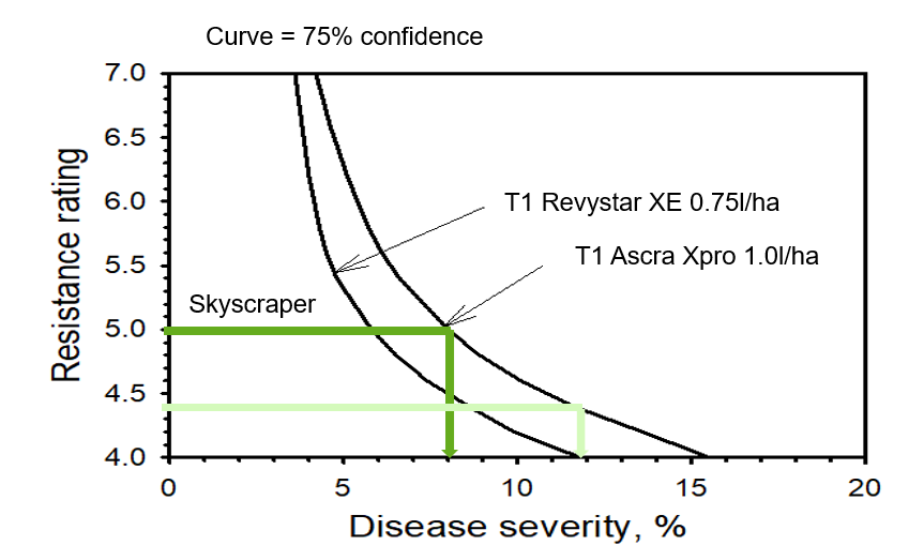
Using the variety LG Skyscraper as an example, Steve explains that in 75% of cases, a usual drilling date combined with a fungicide programme of Ascra Xpro at 1.0l/ha T1 followed by Univoq at 1.25l/ha at T2 and Proline at 0.4l/ha at T3, would result in a 75% probability of no more than 8% septoria severity shortly before harvest. That means up to 8% of the crop’s green leaf area would be lost to septoria infection. In a year like this, with the resistance score effectively dropping by 0.6 to 4.4, due to earlier drilling that would rise to 12% disease severity.
“However, if you swap the Ascra Xpro for Revystar® XE at 0.75l/ha at T1, the data analysed in ADAS’ fungicide calculation shifts to the left. In a normal year and drilling date, according to AHDB data, you’d expect no more than 6% disease severity. However, when drilling is moved 14 days earlier and the RL resistance rating effectively drops, that only increases to 8% which is the infection seen with the Ascra programme at the later drilling date. Switching from Ascra Xpro to Revystar® XE at T1 removes the impact of drilling earlier,” explains Steve.
It’s an important learning for Steve who recognises the pressure growers are facing.
“Following a difficult couple of seasons, growers are facing multiple challenges. Margins are tight and the weather is favouring septoria but there is yield potential and there is every reason to optimise fungicide programmes as far as possible. For Ascra Xpro users who’ve drilled winter wheat early, that means swapping to Revystar® XE. It’s a proven all-rounder and in the worst-case scenario you’ll get increased efficacy and better value.”