
Inclusive Farm Scotland has welcomed the first students to its 22-acre working farm at Tarland on Royal Deeside as the charity’s purpose-built facilities near completion. Through significant fundraising efforts, what was ley ground and old stone buildings has been transformed into a fully operational and accessible training farm complete with new buildings, machinery, livestock, and reseeded grassland, now welcoming students and visitors from around the world.
Co-founder Mike Duxbury completely lost his sight aged six. Despite this, he was determined to pursue his passion and became the first blind person to attend Warwickshire College of Agriculture, leaving with a degree in animal nutrition. Mike was previously Head of Diversity at Vodafone; experience he now channels into helping people with disabilities access both agriculture and adaptive technology.
“Don’t look at the disability, look at the person,” Mike said at this year’s Turriff Show Business Breakfast. “Agriculture is facing a massive workforce crisis, yet we’re overlooking a huge pool of talented, passionate people simply because they have disabilities. Give them an opportunity to show you what they can do – it’s not just the right thing to do, it’s good business.”
It’s this philosophy that led Mike and his wife, Ness, to establish the first Inclusive Farm in Bedfordshire six years ago, created to show people with disabilities a route into agriculture and give them the confidence to pursue worthwhile and fulfilling careers. Keen to expand throughout the UK, the couple then took on a 22-acre tenancy on Royal Deeside, courtesy of the MacRobert Trust, and established Inclusive Farm Scotland at MacRobert (IFSAM) at Newton of Drummy Farm, just outside the small village of Tarland in Aberdeenshire.
A range of livestock has made the farm their home this summer, including a herd of young store cattle and a flock of sheep that arrived in recent months. Two heifers donated by the Vance family at Balnab Farm in Dumfries and Galloway are due to arrive shortly. The most recent addition is Heck, a Suffolk tup lamb from the Cranorskie Suffolks flock, donated by John-Paul Duxbury and his family business Rapid Project Development (RPD). Mike is now seeking Suffolk ewes to complete the flock.
RPD has also donated hay and straw to support the farm and has been the main contractor developing a new building which will house the training and meeting facilities, and livestock areas, with work due to be finished by the end of the year. There is also a separate horticulture area with the addition of a new polytunnel where visitors can learn about growing vegetables and flowers.
The new shed, which measures 40ft x 105ft sits at the heart of the farm, and its design was all Mike’s creation – a model built entirely from Lego blocks. Working with the interlocking bricks, Mike designed every aspect of the layout, from livestock pens to training spaces and accessible toilets. “The dream is now becoming reality, and it’s coming together tremendously. The builders love telling people they’re building a shed designed entirely by a blind man – it challenges everything people assume is impossible,” Mike grins.
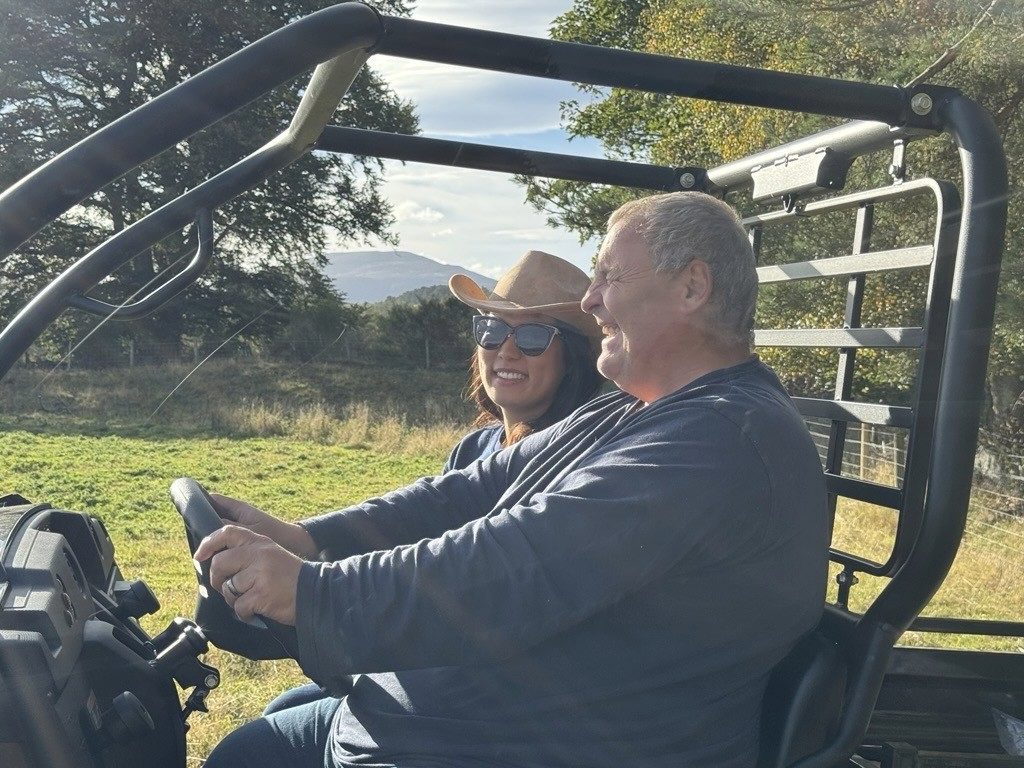
This ‘can-do’ attitude defines Mike and his belief that there’s nothing a blind person can’t do, which for him, includes using chainsaws and driving machinery on the farm. However, the learning experience at IFSAM isn’t all about farming and caring for livestock, Mike admits. “People arrive passionate about farming but unsure if they’ll be given a chance. They will leave having bottle-fed lambs, herded cattle, operated machinery – with the evidence to prove to any employer they can do the job. That confidence changes everything.”
Visitors to the farm to date have travelled from as far away as the United States; Julianna from New Jersey stayed at Newton of Drummy for a week in September. “Julianna came to us because, due to being blind, she couldn’t find any farms in the States that would offer her work experience. She has now gone off to study Philosophy at Oxford University but will return next summer for another residential experience,” said Mike.
Currently, a seventeen-year-old is completing a 12-week residential placement, funded by Cumberland Council. The student, who has little-to-no sight, had never used a mobile phone before arriving at the farm. “We’ve helped him discover how adaptive technology can make life easier,” said Mike. “He’s not only learning about feeding livestock and the daily routines of farming, but he’s gaining independence – safely making hot drinks, doing his own washing, living confidently on his own terms.”
The farm is already demonstrating its wider impact on employment too. A local resident who had been long-term unemployed due to his disabilities began volunteering one day a week and is now likely to take up a paid position at the farm. “This is the whole point,” said Mike. “We’re not running a care experience – we’re proving these are capable employees and creating real career pathways. He came here unemployed and will now be our employee.”
The farm is now accepting bookings for day visits and residential placements. When complete, the new facilities at IFSAM will be able to accommodate multiple students simultaneously, with enquiries already coming in from private individuals, schools, and organisations across the UK.
For more information about bookings or to support Inclusive Farm Scotland, go to https://inclusivefarmscotlandatmacrobert.org.uk/